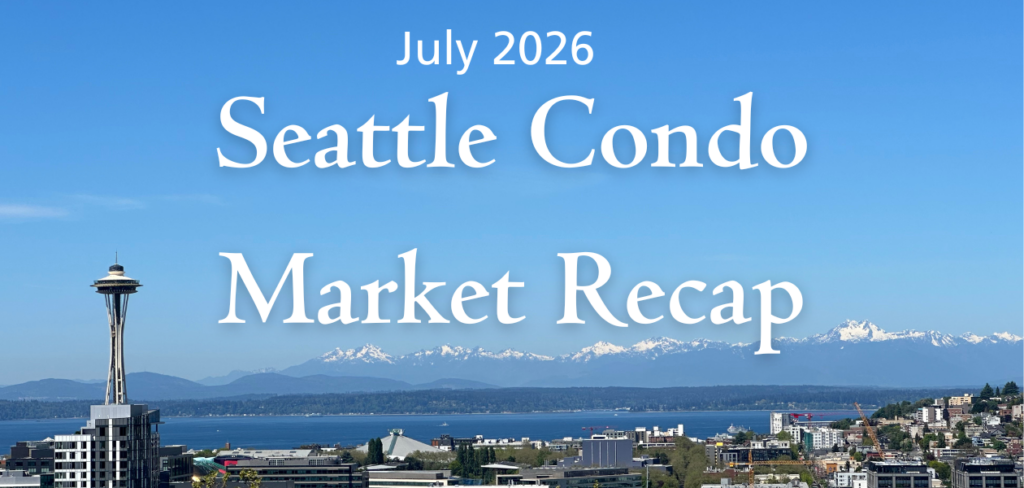
Seattle Condo Market Recap July 2026
Perhaps it’s just an anomaly. A blip. An Aberration. Seattle’s real estate market is historically cyclical. We usually follow the same pattern year after year — the market starts to ramp up in the Winter, activity peaks in the Spring, then plateaus in the Summer before hibernating in the Fall.
We started 2026 as expected – the market ramped up with the start of the new year before peaking in Spring. However, the condo market seemed to have missed a step – the Summer plateau – instead morphing into the Summer Slump. Seattle’s condo market continued to underperform 2025 with lower selling prices, fewer sales and more inventory.
Selling Prices Trend Down
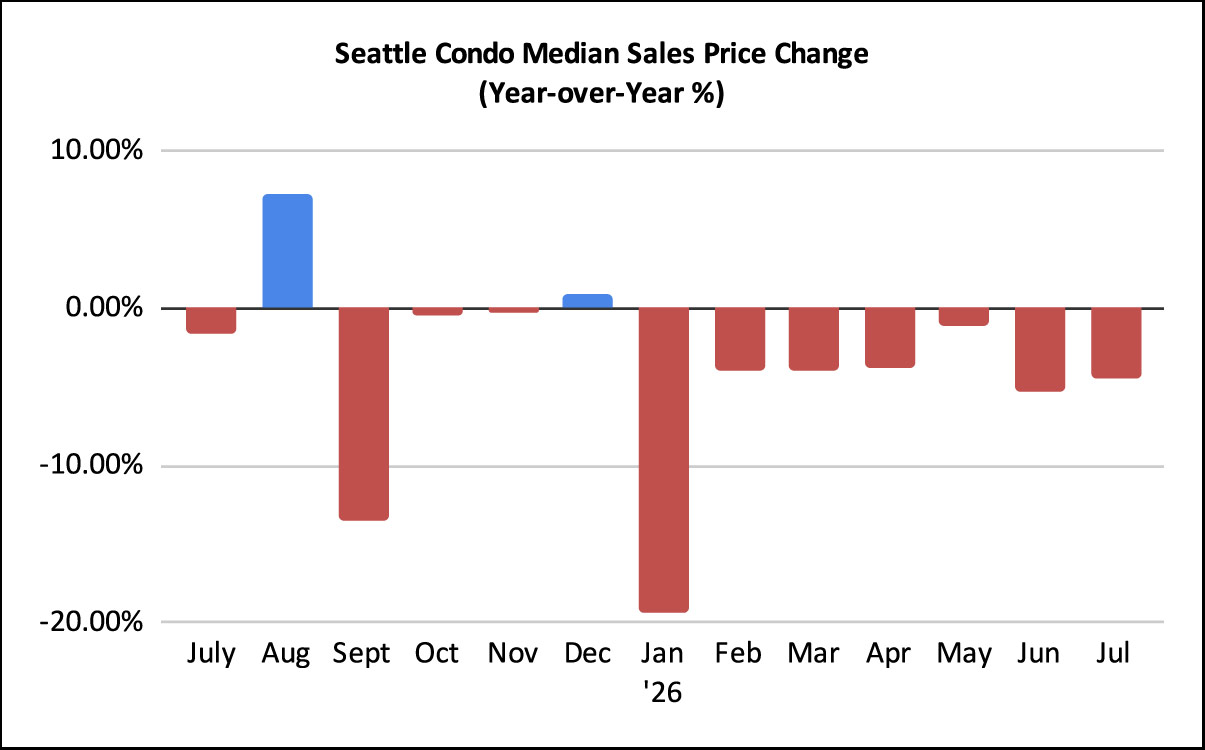
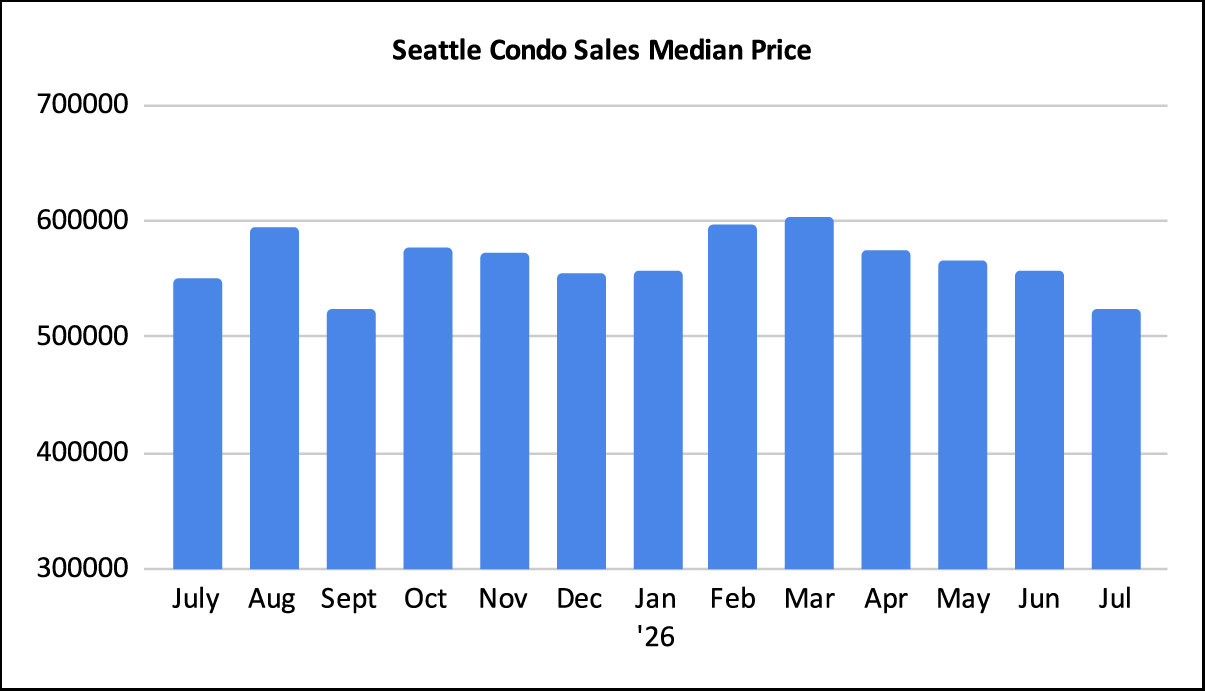
The Seattle citywide median sales price for condos was $525,000 in July. That reflected a modest decrease of 4.6% year-over-year as well as a 5.8% dip from the prior month. In looking at the graph below, that’s basically how selling prices have faired this year compared to last year.
Not all areas of Seattle underperformed, however. The Magnolia / Queen Anne area realized a 6.3% increase in its median sales price relative to the same period last year, but did slip 5.3% from June.
West Seattle’s median sales price shot up over 57% compared to July 2025. However, that’s primarily due to the property type and price point. Last year 74% of the properties sold were traditional condo units and 26% were townhomes. This year, on 48% were traditional condos, which are usually older and lower priced – while 52% were townhomes, which are newer and higher priced – moving the selling price mid-point up significantly. Click here to view neighborhood results.
The NWMLS has a broad definition of “condominium”, which comprises a wide range of property types including the traditional individual unit in a multi-unit building or complex, as well as properties we don’t typically associate with condominiums. These non-traditional properties consists of townhomes, condoized single family houses, accessory dwelling units (ADU), detached accessory dwelling units (DADU, which are essentially a single family house), floating homes, moorage and deeded parking spaces. Non-traditional condos are typically newer and more expensive, thus their inclusion in the condo category impacts the median sales price.
For instance, in July 2026 non-traditional condos accounted for 29.4% of all condo sales with a median sales price of $745,000. That reflected a very slight 0.04% increase year-over-year, but also a 6.9% decrease from the prior month.
Conversely, traditional condo sales had a Seattle citywide median sales price of $465,000 last month. That represented a healthy 9.4% increase year-over-year, but also a 4.1% one-month drop.
Inventory Aplenty
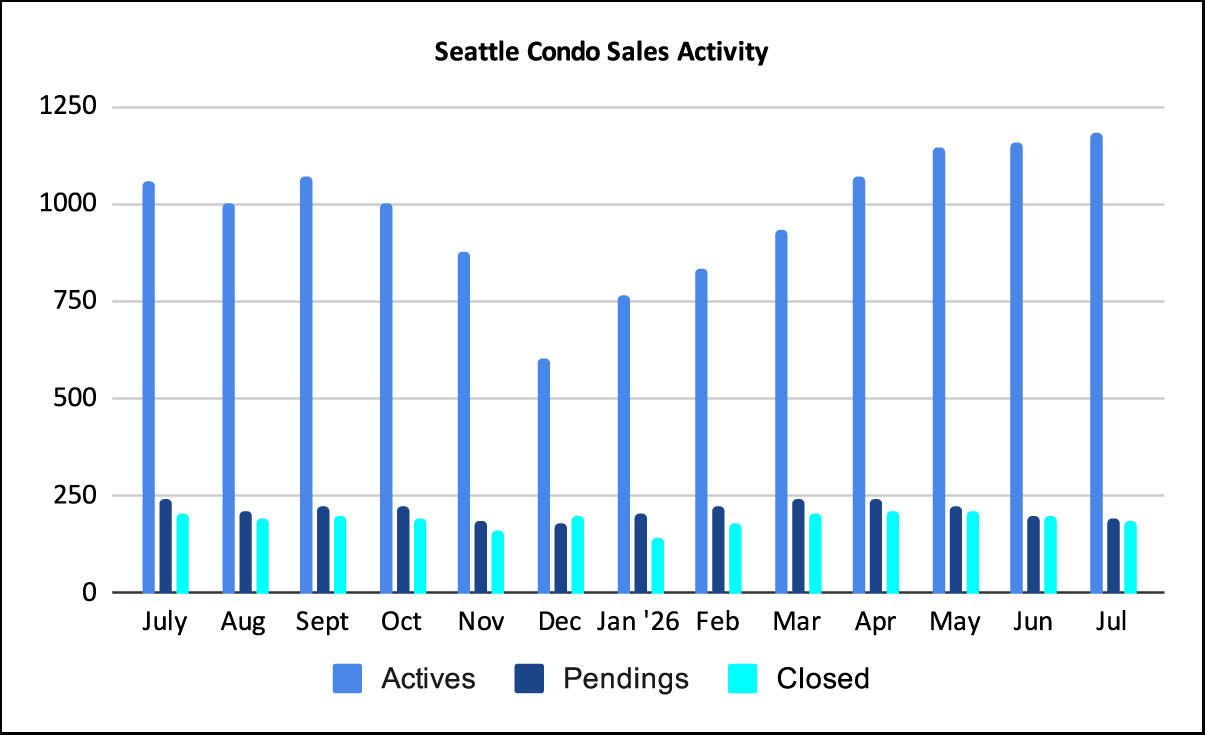
Seattle’s condo Inventory rose in July, but marginally. The number of active units for sale was 1,180 at month end. While that was 11.7% more compared to last July, it only grew by 2.1% from the previous month, or just 24 units.
We started the month with 1,156 units for sale and sellers added another 478 listings throughout month for a total of 1,634 units. Of that amount, 454 came off the market leaving 1,180 units at month end. Units came off the market dues to sales, listings being cancelled or expired, or because sellers opted to rent the unit instead of selling.
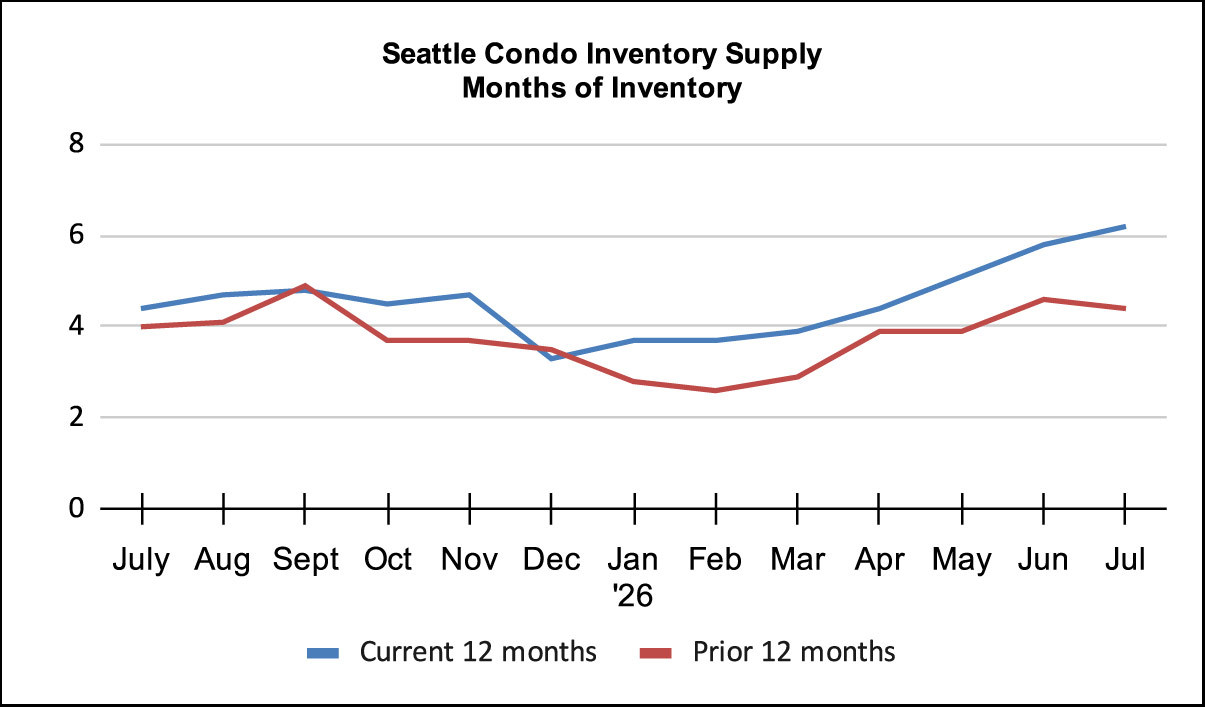
The increased listings led to a rise in the inventory supply rate to 6.2-months of supply. That maintains Seattle, as a whole, in a balanced / normal market environment. Though, we are inching closer and closer towards a buyer’s market.
The inventory supply rate categorizes the current market environment. A rate of less than 4-month of supply is considered a seller’s market. A rate between 4 to 7-months is a normal or balanced market. And, a rate more than 7-months would be a buyer’s market. We calculate the supply rate using pending sales transactions.
One item of note I came across was the downtown / Belltown area. For a few months it has been ensconced in a buyer’s market based on its supply rate. In June, it had an 8.7-month supply rate, but in July it went down to 6.7-months moving from a buyer’s market to a balanced market. The number of downtown listings fell in July while sales increased, one of the few bright spots last month. Market conditions can change quickly, particularly statistics, since we’re dealing with relatively small sample sizes.
Condo Sales Tumble
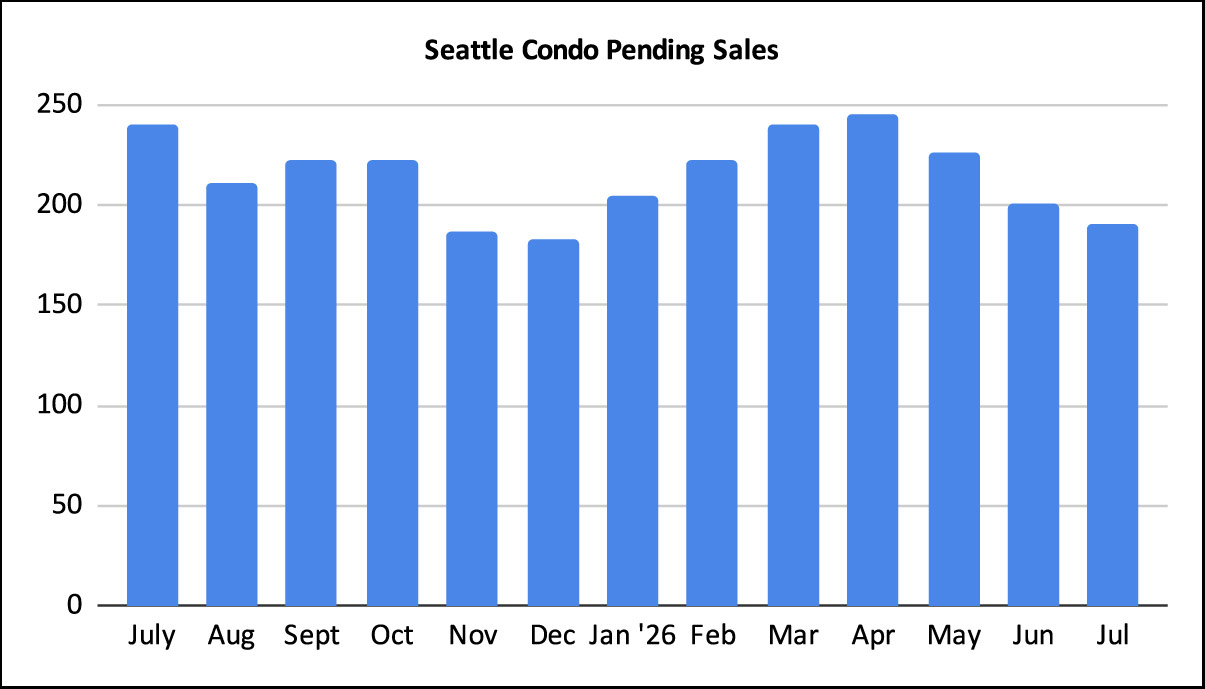
The number of Seattle condo sales dropped in July, with only 191 units going into pending status (listings with accepted offers in escrow). That reflected a 20.4% year-over-year and 5% month-over-month decrease, respectively.
Historically, we’d experience a sales activity plateau during the Summer months, however, 2026 seems to be bucking our cyclically trends. Since peaking in April, condo sales has been plummeting rather than stabilizing. November & December is our slowest months for sales and we’re rapidly reaching that level.
Employment uncertainty have sidelined many condo buyers, particularly from the tech sector that drives the downtown area condo market. Financial market fluctuations have impacted investments, savings and 401K portfolios. The war and other global events have affected inflation with rising prices and mortgage rates.
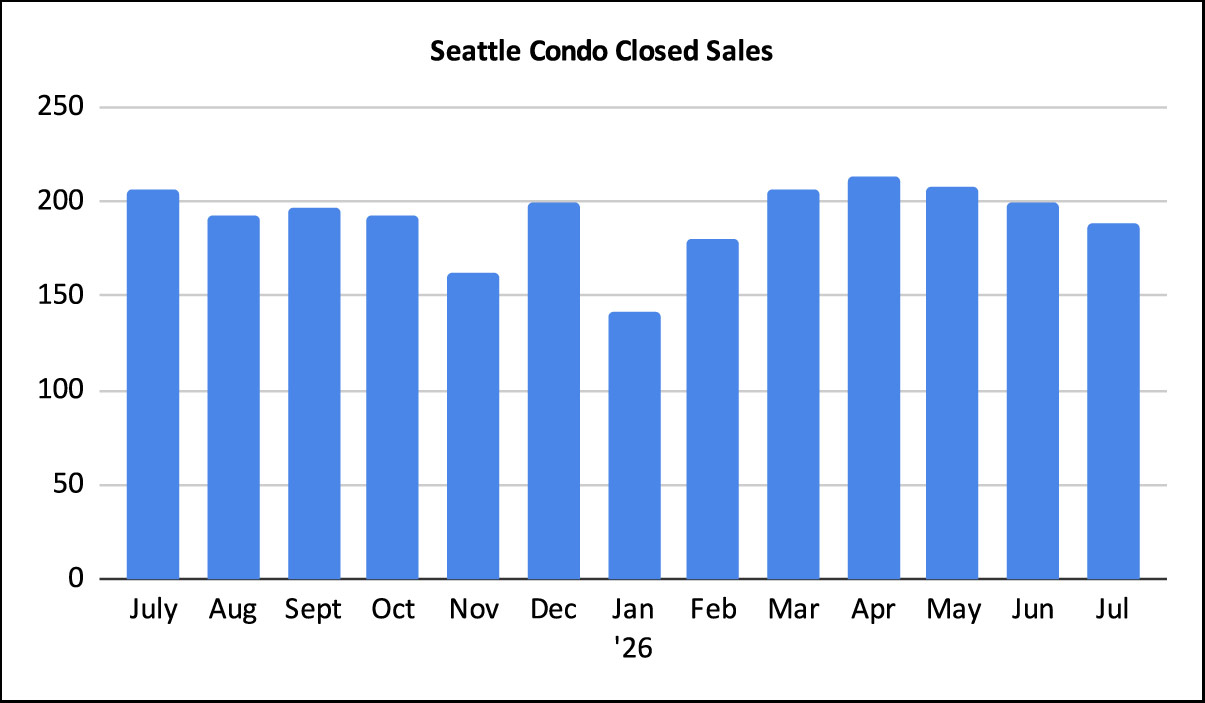
There were 189 closed Seattle condo sales in July. That was a 8.7% drop from the same period last year and a 5.5% dip from June.
In Summary
The Seattle condo market started the year strong but it’s since taken a little bit of a detour and going off script. Historically, the market plateaus and stabilizes during Summer, however, this year the market is slowing and softening a few months earlier than expected.
Sales have plummeted to a level we’d typically see during Fall and selling prices are not far behind. Numerous external factors have been impacted the local real estate market and condos are getting the brunt of it.
There are silver-linings, of course. If you’re a buyer, then the softer market place offers more inventory choices, slower sales velocity and better prices providing opportunities we’ve not seen in the Seattle market for many years. And anticipating upcoming changes to condo mortgage guidelines in the new year now creates favorable conditions for buyers. It’s likely few condos will quality for mortgages once 2027 starts.
It’s a different outlook for sellers. There is more competition as inventory grows putting pressure on pricing and longer market times. But, condo sellers need to be ahead of the mortgage guideline changes as that may make it even more difficult to sell in 2027.
Seattle Condo Market Statistics July 2026
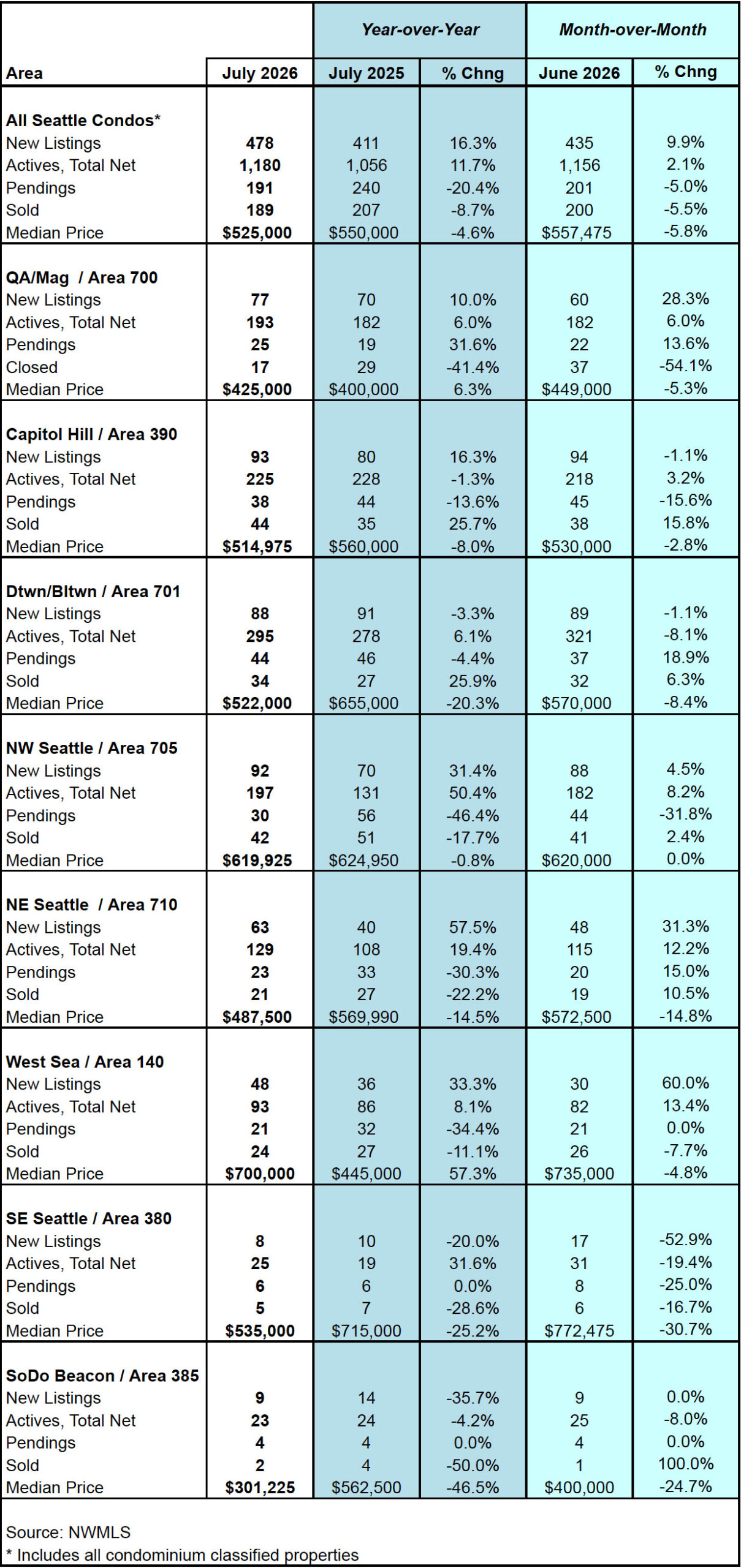
Source: Northwest Multiple Listing Service. Some figures were independently compiled by Seattle Condos And Lofts and were not published by the NWMLS.
© SeattleCondosAndLofts.com